
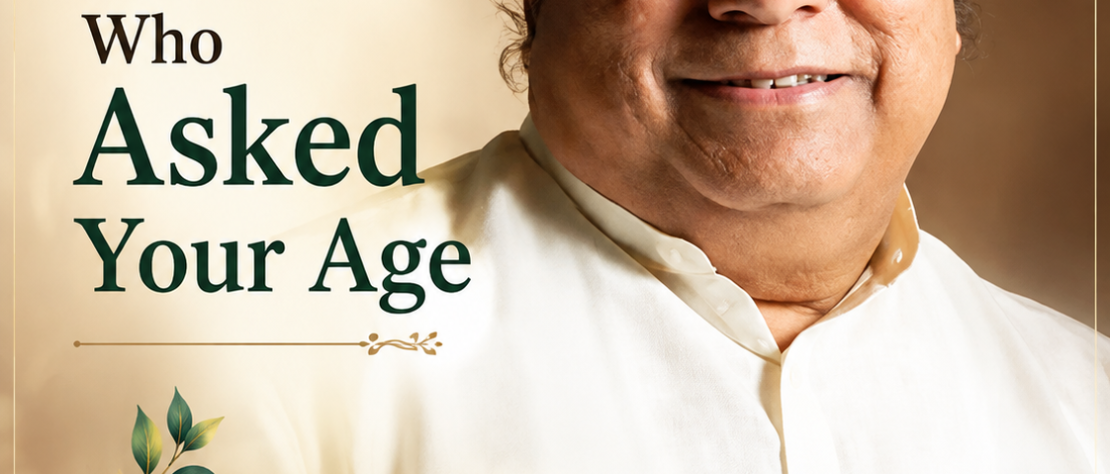
Dr D. Y. Patil (1935–2026) rose from a farming village in Kolhapur to build one of India’s largest private education networks. He also kept a diary of birthdays.
By Vijay Gaikwad
The call always came early in the morning, and it always began the same way.
“How old are you now?”
Then three sentences, in the order he preferred them: Make progress. Be successful. And take care of your health. Then he would hang up.
I first took that call when Dnyandeo Yashwantrao Patil was Governor of Tripura — a constitutional functionary sitting in a Raj Bhavan two thousand kilometres from Maharashtra, dialling a working journalist’s number himself because he had remembered a birthday. Anyone who has spent two decades covering public life in this state will tell you how rare that is. Access to power today runs through public relations agencies, personal assistants and appointment diaries. Greetings arrive as broadcast messages with the name field changed.
Dada, as three generations called him, did not operate that way. The veteran journalist Madhukar Bhave, who knew him for fifty years, has written that Patil habitually asked people he had just met for their date of birth, and when asked why, explained that it gave him one more occasion in the year to congratulate someone. Bhave recalls that in the years when Patil’s memory was still sharp, a morning rarely passed without forty or fifty such calls.
That is not an anecdote about charm. It is a clue to the method of a man who spent seven decades accumulating people, and then built institutions out of them.
Ambap to Rajaram College
He was born on 22 October 1935 in Ambap, a farming village in Kolhapur district, into an agricultural household of modest means and Warkari faith — a lineage he invoked till the end, crediting saints and gurus rather than himself for whatever he achieved. He graduated from Rajaram College in Kolhapur and took a law degree with first-class honours from Shivaji University.
He never really practised. Kolhapur in the 1950s and 60s was a district in ferment: cooperative sugar factories were rewriting the rural economy, Shivaji University had just been founded, and the wrestling akharas still commanded as much loyalty as any political party. Patil moved comfortably in all three worlds. He wrestled — Bhave notes that Patil was almost certainly the only Maharashtra politician to have grappled with Khashaba Jadhav, independent India’s first individual Olympic medallist, and that he kept a photograph of the bout.
Public life began locally. He was elected to the Kolhapur Municipal Council in 1957, and went on to represent the Panhala constituency in the Maharashtra Legislative Assembly through the late 1960s and 1970s. He wanted Gaganbawada; the party gave him Panhala. He took it, won it, and served two terms.
He was a Congressman of the Vasantdada Patil and Rajarambapu Patil generation — a school of politics in which a leader was measured less by his speeches than by what he had built and whom he had helped. Patil belonged to it entirely. But unlike most of his contemporaries, he read the ceiling of electoral politics early, and stepped away from it.

The pivot of 1983
In 1983 he founded the D. Y. Patil Educational Complex. It was the decision that defined the rest of his life, and in retrospect it was an act of unusual timing.
India then had a structural problem that governments were not going to solve alone. Demand for professional education — medicine, engineering, management — was rising far faster than the state’s capacity to create seats, and public spending on education was, decade after decade, falling short of the targets successive commissions had set. Whether one welcomed it or not, private capital was going to enter that gap. The question was who would enter it, and with what intent.
Patil entered it with scale. Over four decades a single complex grew into a network that today spans Kolhapur, Pune, Mumbai and Navi Mumbai — by most counts more than 180 institutions, including seven deemed universities, medical and dental colleges, engineering and management schools, nursing colleges, international schools and a chain of hospitals attached to them. The Government of India awarded him the Padma Shri in 1991 for education and social service. In Maharashtra he was called Shikshanmaharshi.
What that word obscures is the economics of the thing. When a university campus comes up, it is not only buildings that come up. Hostels, hospitals, transport, small businesses, contractors, canteens, rented rooms and thousands of jobs come up around it. A single institution can change the character of an entire locality. That understanding — that education is also infrastructure — was common to the institution-builders of his generation: Patil, Patangrao Kadam, Balasaheb Vikhe Patil, Datta Meghe. It is the reason their names are attached to pin codes and not merely to buildings.
The argument he never fully won
An honest account cannot stop there. The rise of the private professional college in Maharashtra was accompanied by a persistent public argument about capitation, about fee structures that put medicine and engineering beyond the reach of exactly the farming households men like Patil came from, and about whether “education emperor” was a title or an indictment.
Patil rarely argued the point in public. His defence, to the extent he offered one, was the arithmetic: the seats existed because someone created them, and lakhs of doctors, engineers, researchers and entrepreneurs came through them who would otherwise have had nowhere to go. Those who worked closely with him also point to the ledger nobody published — the admissions arranged for students who could not have got in, the hospital bills quietly written off. He did not advertise any of it, which is both a personal virtue and, for a biographer, an inconvenience.
Both things are true at once. He widened a door that the state had left too narrow, and he was part of a system that made the widened door expensive. Maharashtra has still not resolved that argument. He simply built while it went on.
Stadium, Raj Bhavan, and the refusal of pomp
In March 2008 the D. Y. Patil Stadium opened at Nerul in Navi Mumbai — a Hafeez Contractor design with a capacity upwards of 45,000, column-free sightlines and bucket seating, conceived and driven by his son Vijay Patil. It has since hosted IPL and international cricket, the ISL, the FIFA U-17 World Cup and stadium concerts. It is an odd monument for an educationist, until you remember the akhara. He knew his cricket in detail and his wrestling better; he had followed Shripati Khanchanale, Ganpatrao Andalkar and Maruti Mane the way he followed his students.
The constitutional phase came late. He was appointed Governor of Tripura in 2009, moved to Bihar in 2013, and briefly held additional charge of West Bengal. Governorships in India are not usually remembered for content; Patil used his to push rural education access and public health infrastructure, which were the only two subjects he had ever really been interested in.
What people remember more is what he refused. He did not, by the accounts of those around him, allow the honorific weight of the office to attach itself to him. As a former Governor he declined a police escort ahead of his car. He declined one for his son too, when Satej Patil was Minister of State for Home. He wore a step-counter and would show visitors how many thousands he had walked that morning, and he swam an hour a day well into his eighties.
The last of a line
He died on the morning of 4 August 2026 at his home in Kasba Bawada, Kolhapur, after a prolonged illness. He was 90. The Maharashtra government accorded him a state funeral at the Pavilion Ground in Kasba Bawada, on the campus of the old D. Y. Patil medical college. Shops and institutions across the suburb shut. Condolences came from the Prime Minister, from Rahul Gandhi, from Sharad Pawar, and from tens of thousands of former students who had never met him.
He is survived by a large family and a working political and educational succession: Sanjay Patil, who heads the group; Satej “Bunty” Patil, MLC and former minister; Vijay Patil and Ajinkya Patil in Mumbai; his daughters; and his grandson Ruturaj Patil, a former MLA from Kolhapur South whose 2019 campaign the then 84-year-old Patil worked door to door — something he had never done for himself.
There is a particular generation of Maharashtra’s public life that treated politics as a means of construction rather than an end in itself, and measured a career in institutions rather than terms of office. Dada was among its last significant representatives. When they go, what ends is not merely a life but a way of being powerful.
The buildings will stand. The universities will graduate their next batch. But somewhere in Maharashtra this October, a few hundred people will have a birthday and the phone will not ring at seven in the morning with a voice asking how old they have become — and telling them, in that order, to make progress, to succeed, and to look after their health.
Vijay Gaikwad is a senior agricultural journalist and policy analyst based in Mumbai.